


Part 1: Can scientific revolutions be engineered through human coordination?
Historically, scientific revolutions chiefly began by chance. They are, almost by definition, hard to identify in advance, fund the pioneers of, initiate, and execute. And thus, they are difficult to accelerate. In our first essay, we discussed the scientific revolutions that occur when certain scientific fields reach their “ground truth”. By “ground truth”, we mean an understanding of the fundamental building blocks that make up the systems of interest in a scientific field, and how those building blocks interact within those systems.
Once you have such a fundamental description of a field, the “science risk” of making inventions in that field is reduced. By this we mean the risk that a new invention - a designed system made out of the aforementioned building blocks - will fail due to unknown scientific principles. There’s always risk associated with inventing something new (e.g., engineering risk, execution risk, market risk). But science risk represents the true “unknown unknowns” of a field - things you cannot really prepare for. In fields with such science risks, creating something new is something of an art form. Fields like this, however, can be transformed via ground-truth understanding into more predictable design- and engineering-oriented disciplines. Then, the assembly of building blocks into new inventions, as well as the repair of existing complex systems, becomes less art, and more engineering.
The discovery of quantum mechanics in physics, and of the periodic table and the molecular bond in chemistry, are examples of such scientific revolutions of the past. Each revolution yielded a ground truth, and each ground truth then triggered a burst of practical invention, from microchips and lasers to the internet and cell phones, amongst countless others.
Take the example of the microchip. Before quantum mechanics, nobody could fathom that you could take sand off a beach and convert it into an intelligent machine. Even science fiction writers could only dream up computing machines made of mechanical switches or gears. Quantum mechanics provided science de-risking that led to the microchip. The microchip that resulted then enabled people to drop out of college to build some of the biggest companies of our time: Apple, Microsoft, and Facebook (see the essay1 for more thoughts on this example). The moon landing is a similarly iconic outcome of the ground-truthing of physics - indeed, becoming the iconic example of high-ambition scientific achievement (hence all the scientific projects that are called “moonshots” these days).
Biology has no such ground truth description yet. We simply don’t have a list of all the relevant building blocks of life, and an understanding of how they interact. As reviewed in our first essay, biological systems like the human body are made up of a very large number of different types of building blocks (thousands of kinds of biomolecules), compared to physics (which has a handful of kinds of particle) or chemistry (which involves dozens of different kinds of atom). That difference in complexity makes the space of possible system states in biology so much higher-dimensional than in physics or chemistry.
Developing a treatment or cure for a disease means creating an intervention (e.g., a drug) that causes the biological system to navigate from a diseased part of this state space, to a healthy part of this state space. Navigating such a high-dimensional space without knowing the underlying building blocks and interactions is extraordinarily difficult, and success ends up depending on exceedingly rare and costly luck. Understanding the fundamental building blocks of life and how they interact would allow the comprehensive analysis and simulation of a biological system, enabling accurate predictions of the efficacy and side effects of a candidate drug. Until that understanding exists, most non-infectious diseases will almost certainly remain incurable, treatments that are found will be partial in efficacy and have side effects, and translational research arcs (including clinical trials) will continue to take many years and cost billions.
There is much hope in biology and medicine that collecting enough data will allow AI to predict drugs and estimate efficacy and side effects. But as long as AI operates on phenomenological data, however large the quantities, it will struggle to solve out-of-training-data problems. Curing a disease, by definition, is one such problem: a cure is a result no existing data contains. Without ground truth as its foundation, AI navigates the same high-dimensional biological space phenomenologically like everyone else. Its knowledge base only allows it to explore a tiny crumb of the exponentially large space at hand, and while speed helps it go through that crumb faster, it doesn’t really make it bigger. The unknown unknowns remain thus.
The phrase “ground truth” has independently come to be used in the field of AI to mean the data used to train an AI on, but the two meanings of “ground truth” are not in conflict. If AI is trained on ground truth data in the sense we define it, it can be wildly successful, with good generalization power. AlphaFold’s ability to predict protein structure is a canonical example of this: it was trained on hundred of thousands of solved protein structures, acquired over decades. These structures served as ground truth data, because they revealed the building blocks (amino acids) and how they were organized (protein structures).
Indeed, we have ground truth in a few subdomains of biology. One is genomics, which relies upon the ground truths of the double helix of DNA and the 4-letter genetic code. A second is protein sequence, which relies upon the ground truth amino acid alphabet and the triplet codon code. But no ground truth datasets exist for cells, much less tissues, organs, and organisms. With thousands of kinds of biological building block to consider in such systems, AI will be necessary to analyze such datasets, when acquired. But the data must exist first, and the tools to acquire the data need to be invented. Prototypes of some of these tools exist, but they need to be fully realized, optimized for practical application, validated with gold standards, scaled up in throughput, and applied systematically. At the end of the day, AI is a great output to aim for, but you need the right input to make the AI work.
The high-dimensional knowledge gap we describe above is daunting, in that no amount of material resources can buy your way out of it if spent only on applying existing technologies. A billionaire undergoing neurodegeneration, for example, can’t do much to slow or stop the process. Wealth can buy access to the best treatments that exist, but can’t buy access to treatments that don’t exist. Even throwing a lot of money at research treatments, if done at the phenomenology level (as is the case for most institutes or start-up companies), almost always fails. Exceptions are problems that can be solved by an engineering-oriented extension of the ground truths that we do have. For example, thanks to ground truth knowledge about genomics, and ground truth-oriented tools like CRISPR, some rare monogenic disorders can be treated by gene therapies. But without those ground truths, even these diseases would be intractable.
In short, more money applied within existing paradigms buys more darts to throw in the high-dimensional space of possible biological states, in the hope of coaxing a system to a better state, but the odds of hitting such a target are astronomically tiny to begin with. This is why biological “moonshot” efforts, despite attracting world-class scientists and being equipped with large budgets, rarely produce cures, or even treatments: they are operating on top of the same poor knowledge foundation as everyone else. Simply put, there are things money can’t buy. The fraction of biological system space you can explore without ground truth knowledge, no matter how much money you spend, is not enough to have a high chance of reliably finding a path from a disease state to a healthy state.
Why don’t people just go get the ground truth? The path requires new tools that can acquire the relevant data, and building those tools may sound high-risk to funders and scientific participants, involving fields distant from their expertise. The Human Genome Project and AlphaFold both took a chain of technical innovations to reach, many of which seemed heretical at the time they were proposed. Inventing the required tools took effort from many sets of people, operating from different fields ranging from physics to chemistry to engineering (fields far from the intellectual space of the goal area), over long periods of time - “involuntarily collaborating,” if you will2.
The reluctance to go for the ground truth remains even if the acceleration offered by a tool avoids decades of wasted time. One likely reason is that many scientists and funders focus on the simplest hypotheses available (Occam’s Razor) for a problem they are working on. They only move to more complex hypotheses when simpler ones fail. Alas, in high-dimensional spaces like biology, such a serial, iterative approach of hypothesis falsification will take a disastrously long time. Automation and AI, operating on existing tools and data, offer parallelism, but still not enough to make a serious dent in the problem.
These observations lead to an interesting question: what if engineering a scientific revolution is, at least in part, a problem of organizing humans and coordinating effort? If so, then achieving ground truth, and generating practical outputs based on that ground truth, is a problem of leadership and organizational structure, and not only thinking and experimenting. Perhaps we can’t think our way out of the problem alone, but we can organize our efforts towards the scientific revolution we seek.
The moon landing itself was a feat of engineering, more so than science: the underlying physics foundation was solid, so the science risk was low. But imagine attempting a moon landing in the year 1600 (explored more in3). Most likely, all the money on Earth wouldn’t get you there, due to the fundamental scientific unknowns at the time. People would tie kites to chairs, and then die. Could you have launched a moonshot (so to speak) in the year 1600? You’d first have to organize people to go after the ground truth: fund mathematicians to develop calculus, physicists to figure out the laws of mechanics and thermodynamics, and chemists and material scientists to map the elements and work out the principles governing chemical reactions.
But there is a problem with trying to accelerate the path to ground truth physics: realizing what the problems are, and finding the right people to advance this path, are almost as hard as solving the problems themselves. That is because you “don’t know what you don’t know”: for fundamental sciences like physics, you don’t know where the road will end until you get there. Until you have figured out, for example, the set of particles that are relevant to your system at hand and how they interact (e.g., electrons and a handful of other fundamental particles, and the laws of electromagnetism and a handful of other interactions), you are not sure if there are more things or interactions to be added to the list. And, until you have the complete set that is relevant to your system at hand, you can’t really engineer without science risk. (Imagine knowing about electric fields but not magnetic fields. Your ability to robustly make inventions based on physical principles would be impoverished.)
The path to ground truth biology is different in a way that allows it to be accelerated. While problems in physics are fundamental, those in biology and medicine are not - they are network problems, running on top of existing physical principles. The goal of ground truthing biology, then, is to understand biological systems as computational systems that run on top of the building blocks and interactions of chemistry and physics. We know what we are looking for: a list of the chemicals (e.g., biomolecules) and how they interact - which should be, with appropriate technology, measurable and controllable. Thus, we are dealing with “knowable unknowns”. Our hypothesis: at this point in the overall progression of science, network sciences can be revolutionized by networks of people; we just need to figure out how to choose, organize, and facilitate these people.
These were some considerations and challenges on the scientific side of the ground-truthing enterprise. On the business side, it’s common perception that the entities that pave the way for the ground truth don’t profit from it. Quantum mechanics was developed by academic physicists. Later, Bell Labs developed the transistor, the core component of the microchip, while Intel and Texas Instruments developed the microchip. Then, Apple, Microsoft, and Facebook built their for-profit empires on top of this invention, even though none were involved in the original research that made it possible. The question this essay asks is: could a new institutional structure close that gap, accelerating both the achievement of ground truth and the deployment of resulting practical inventions into the world?
In the rest of this essay, we explore the idea that these two problems of discovering ground truth, and developing low-science-risk inventions of great impact, might solve each other if they are connected in the right way. The achievement of ground truth (tool development and application, fueled by serendipity and nonlinear jumps) could be supported by people and resources motivated by the low-science-risk inventions downstream. The latter motivation includes two components, both important. First, the lower risks mean better financial returns - for example, by reducing the time needed to make a drug or the clinical trial failure rate. The other component is not about making money, but having things worth purchasing. If right now “there are things money cannot buy” (many much-desired therapies and cures cannot yet be invented based on current biological understanding and tools), ground-truthing may be the only way to enable them and make them available for purchase. Last but not least, if you invest capital in a traditional venture, or in any single disease-specific effort, you are making a narrow bet: if the drug fails, the money is gone, and there might not be much transferable knowledge to future bets on that disease, or to other disease areas. The same capital, if invested in ground truthing, could close a fundamental gap in biological understanding that supports many outcomes at once. The expected payoff is not one treatment, achieved with low probability, as in traditional venture, but the tools and understanding that make many cures and treatments reachable - offering you, personally, more coverage for the future.
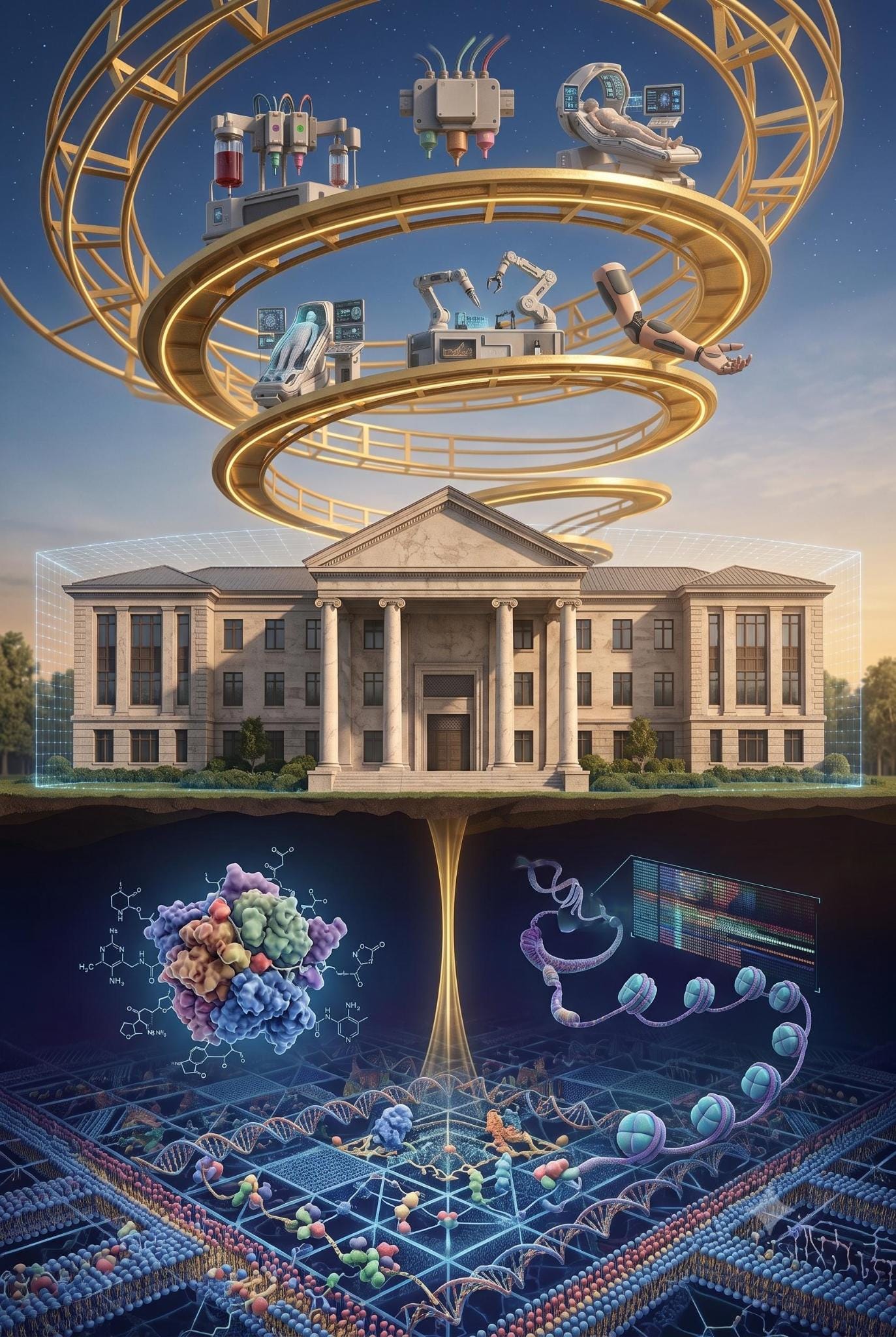
Perhaps such an investor in the ground-truthing enterprise will then be motivated by more than short- or even long-term financial returns. They will want to be able to use their resources to acquire things that they think they might need in the future, but that cannot be acquired at any cost currently. This is an interesting payoff that has not been discussed as much in institutional structures - the optionality for a better future that we will directly be able to access (as opposed to being purely for future legacy). And the downstream inventing can only become low-science-risk, if preceded by revolutionary ground truth. The payoff comes from connecting the dots.
We will focus on the network problem of biology: where ground truth means building and applying tools to see and control the fundamental building blocks of life, and where the low-risk inventions downstream would be treatments and cures, facilitated by AI trained on the aforementioned ground truth.
Part 2: What are the stages of innovation, on the path from discovering ground truth to deploying impact?
Are there precedents for thinking about how to link the quest for ground truth to the creation and spinning out of practical inventions? Many of the ground truths of biology - the structure of DNA, the genetic code for proteins, the human genome - were found quite some time ago. AlphaFold, which builds from the structures of the Protein Data Bank (PDB) and is now yielding many new ideas in drug discovery, is a more recent example, but the ground truth data it was trained on - the structures of the PDB - were acquired over a ~50-year period. Can we go faster? Are there examples that point towards the ground truth understanding of cells, tissues, organs, and organisms, and whether we can accelerate this field? Some people have assembled collaboratives to go after the ground truth - prototype systems, if you will, sometimes without formal structures or systematic funding. They tried things out, and the things that worked, they did more of. The things that failed, they abandoned. Sometimes, these efforts did lead to new structures, with novel kinds of impact. One of us (Ed) has led a group at MIT for 20 years that, in a way, has served as a testbed for such ideas: it became something of a tradition for group members to write a PhD thesis chapter or manifesto about how they would reshape science, if they were in charge. And some went on to make those concepts reality, even creating new structures to realize the concepts. We can learn from these structures, even as we ask what comes next.
For example, a few alumni formulated the idea of the focused research organization (FRO), a non-profit startup that is more focused than an academic lab, but too early to make money like a for-profit company. The thinking about this structure began at MIT, with one student, for example, writing the last chapter of his PhD thesis about the idea. One alumnus then went on to found an organization that launched several FROs, two of which were founded and led by former PhD students from our group (on ground-truth-oriented topics: one to accelerate brain mapping, the other to invent AI scientists). One of those FROs recently spun out a for-profit company to commercialize AI scientists, raising in 2025 a $70 million seed investment round. In other words, alumni created their own ecosystem, inventing new structures to fill a gap in the scientific action landscape, and then populated that ecosystem with entities that are beginning to cross the bridge from ground-truth oriented innovation to for-profit deployment.
There are many other such examples from our group’s alumni. One former student started a hard-science-oriented venture capital firm, which invested money in two other group spinout companies, each taking a ground-truth oriented technology idea out of the lab and towards the marketplace (protein sequencing, 3d nanofabrication). As another student-led example: prompted in part by an MIT-wide competition for new ideas about projects to confront climate change, several students in our lab helped assemble teams and propose projects to remove carbon from the atmosphere, in the end winning not one, but two, $100,000 awards. One student went on to start a venture capital firm to fund companies fighting climate change, and two others started a nonprofit to fund research in biotechnology tackling climate change.
Of course, our group has spun out many more traditionally structured companies as well, working on topics ranging from noninvasive treatments for Alzheimer’s disease, to better drug delivery to the brain, to noninvasive brain stimulators, to wearable devices to help people sleep. Many group members have started labs in academia as well. We have taken on many students from nontraditional paths, including two students who completed PhDs, who never finished a bachelor’s degree. We’ve also had numerous visiting students and scientists join the lab, bringing in new ideas and skillsets, and some acting almost like entrepreneurs-in-residence, who then spin out ventures. About half of the members of the group currently have co-mentors - other faculty - who provide problems to work on, guide them on how to solve them, and help them with strategies. Sometimes I guide someone on tool development, and the co-mentor guides them on the application of that tool to solve a problem, for example. Beyond trying to do the right thing and helping our group members grow, we don’t overprescribe the path. Every problem, perhaps, has a natural home, and our job is to find it. And if that home doesn’t exist yet, let’s invent it.
Diving into more detail about past ground truth trajectories: most such projects begin informally when a scientist in the lab (e.g., a PhD student, postdoc, or research scientist; going forward in this essay, we’ll use the word “student” for conciseness) in the group approaches a hard, real-world problem with a ground truth perspective. That is, by inventing (if needed) a tool to see or control the fundamental building blocks of a system of interest, or (if the tool exists already) applying such a tool to analyze a system of interest at a fundamental level. Call this Stage 1. During this stage, we try to teach problem-solving strategies explicitly, rather than leaving students to figure them out on their own4. Nevertheless, financial support at this early, pre-paradigmatic stage is time-consuming to secure, and often near-impossible to obtain.
Stage 2 occurs after the tool has been prototyped, or a tool application has achieved a value inflection point where the promise is clear - and now it’s time to mature, validate, and make the tool practical, or to acquire further data to complete the understanding of the problem at hand. Stage 2, thus, represents the transition from proof-of-concept (for an invention) or pilot study (for a discovery) to reality. The technology or discovery must be refined in depth, scale, or practicality - which could occur in academia, or in an FRO, or in a startup company, depending on the timescale and resource scale required. (Again, every problem will have a natural home). Currently, such transitions are mostly handled as one-off enterprises, each treated as its own individual case. For spinout organizations, they must rent their own space, make their own benefits and recruiting policies, get their own biosafety approvals, hire their own patent lawyers, and so forth. Perhaps most critical, and challenging, is recruiting the team to go from Stage 1 to Stage 2: you need a leader of the effort (if in academia, perhaps the student has now become a professor; if in a spinout, perhaps the student has become a CEO, but as likely, if not more, is the recruiting of an outside person to be the CEO), and other key team members, to tackle the problems of Stage 2. If Stage 2 continues in the lab where the student performed Stage 1, there will be the need to raise money, and build the team, in academia - which can go slowly, being dominated by fundraising and graduate student admission cycles, which often are governed by a yearly rhythm. Having the right team is critical, and there is no systematic way to go about forming it.
Stage 3 is maturation: now, the value of the invention or discovery is proven. Perhaps the FRO is ready to spin out a for-profit startup and scale, or perhaps the for-profit startup of Stage 2 has an FDA-approved drug on the market, or perhaps the academic project of Stage 2 has gotten to the point where for-profit investment is straightforward to obtain. Now, capital is easier to raise, with time horizons to profitability shortening, and valuations increasing. Traditional capitalistic incentives can help with team-building and scaling.
What gets less recognition: Stage 3 means that something was created that otherwise would not exist. With every Stage 3 that is successfully completed, the problem that “there are things that money can’t buy” is addressed, because now there is something that can be purchased, that wasn’t even possible before. Money itself became more valuable, since it can now get you something previously impossible to acquire, that you might very well personally need. Of course, this new innovation is accessible to everyone, not only to the people who supported and executed Stages 1 and 2. This could be considered a byproduct of the success of the investment.
Regardless of the positive impact the innovation has upon the world, by the time Stage 3 arrives, the behind-the-scenes work of Stage 1, and sometimes Stage 2, has often been forgotten. The contributors to those early stages may not get credit - and most of the time they will not profit from their work, since they will not get patent royalties or equity that is often only allocated in later stages. They may not formally be an inventor on a patent, or be a co-founder of the company, even though without them, the path would have been impossible.
For the most part, today, each of these 3 stages is supported and executed by different teams of people, working in different organizations, each optimized for its own incentives and metrics. The overall set of organizations is fragmented. There is no overarching optimization across it, and no reliable transfer of wisdom or memory from stage to stage, apart from specific individuals who carry through (which does not always occur). Stage 3 may generate lots of profit and economic value by making available things that money can’t buy, yet there is no straightforward mechanism for the pioneering work of Stage 1 to utilize the financial benefit associated with that future promise, nor is there a direct way to reward the brave and serendipity-chasing pioneers who make Stage 1 work. (Stage 3 successes could, in principle, philanthropically fund new Stage 1 entrants, but that will happen long from now, too late to support current Stage 1 innovators. And because of the separation of Stage 1 pioneers and Stage 3 successes by the intervening Stage 2, there may be no personal connection to help facilitate interaction.)
Stage 1-style innovators often pay a price for this and lead a hard life. Look at how many people who did Nobel Prize-worthy work have a story of struggle behind them, even as they laid foundational groundwork that might have seemed far from application, and that made slow progress. Katalin Kariko (Nobel Prize, 2023) was demoted by UPenn, where she did her foundational work on RNA chemistry that led to RNA vaccines; Brian Kobilka (Nobel Prize, 2012) was not renewed as an HHMI employee while he sought to solve the structure of the G-protein coupled receptor; Doug Prasher, who cloned the gene for the green fluorescent protein (GFP), ended up driving a shuttle bus for an auto dealership. And these are just some of the examples we know about. How many other ground truth-oriented pioneers were unlucky, or lacked the “business” skills needed to stay in the game, and were not even able to get this far? Pursuing ground truth is tough, as we outlined in the beginning of the essay. But our institutions, it seems, often make it even harder. (Even the stories that kicked off this section of the essay were possible, most likely, due to a lucky event: Ed only got a faculty job at MIT in the first place due to a stroke of serendipity, after having been rejected by most of the departments he applied to at universities5.)
How can we ease the paths of Stage 1 pioneers? One way is through logical argument - by helping people realize that achieving ground truth is worth it, and perhaps the only path that will really get us to the finish line. As other approaches fail, more and more people are starting to appreciate the need for ground truth in biology and medicine. But a synergistic way is by connecting the rewards of Stage 3 to the facilitation of Stage 1, in as direct a way as possible. Could we design a new organizational structure that can catalyze Stage 1 right now, accelerate the progression to Stage 2, and then realize Stage 3 as fast as possible?
We now explore a new structure - the Ground Truth Institute (GTI), let’s call it, for the purposes of this essay - that unifies the different stages outlined above, so as to support the earliest stages of innovation, which often appear too high-risk to attract funding, while simultaneously supporting the translation of innovations from lab into practice, to serve the generations alive today. The key insight is that these two needs help solve each other. The promise of supporting getting innovations into the marketplace (including to make them available to yourself - maybe there are things money can’t buy now, but money could buy them in the future) provides resources to the earliest stages of invention and discovery, and if the invention and discovery is ground truth-oriented, then it derisks the path of getting an innovation out of the lab and into the marketplace.
As in the above sections, we’ll focus on biology and medicine, because of the great need (both in understanding and human suffering) exhibited by these fields, and because of the imminent opportunity at hand. Thus, the GTI would aim to achieve the complete understanding, modeling, and repair of biology and living things - brain diseases, aging-related diseases, and so forth. Stage 1 would be the building of the tools that enable the mapping, control, and simulation of living things, down to their fundamental building blocks and interactions thereof, in healthy and disease states. Stage 2 would be the scalable collection of data from a diversity of systems, for example of the human body, in healthy and disease states, as well as the training of AI on such ground truth data (see 6 for one such proposal), and the use of AI to pinpoint optimal targets for remedying disease states. Stage 3 would be the development, trialing, and deployment of therapies based upon such data. Because of the ground truth derisking enabled by Stage 1, Stage 3 will be lower risk, meaning higher efficacy and lower rates of side effects, and lower clinical trial failure rates, than previously possible. Because of the promise of improved economic returns of Stage 3, and the personal payoff that arises from having more therapies available (i.e., the things money couldn’t previously buy), there would be added incentives to financially support Stage 1. Indeed, perhaps the key idea is to create a community of supporters and executors who want to participate in all 3 stages: a single financial supporter might want to support Stage 1 in order to derisk Stage 3, and also to support Stage 3 so as to benefit from the derisking of Stage 1 (at preferred terms as compared to other people starting their support only at Stage 3).
Most likely, the overall structure of the GTI would benefit from being a nonprofit, as such a structure could more easily collaborate with universities, using and sharing intellectual property, but with a team ready to spin out for-profits to commercialize Stage 3-ready technologies ready for more scalable investment. By having a shared set of funders and a unified structure, GTI could facilitate a ground truth-oriented culture that realizes concrete outcomes that improve human life.
Part 3: How would this work, in practice?
Let’s now imagine a “day in the life” of GTI, for people and projects at each of the 3 stages. In Stage 1, students (again, shorthand for all the scientists within groups at the institute) tackle real-world problems in biology or medicine, focusing on a ground truth perspective. The strategy is to begin with the end in mind and work backwards, with the goal of understanding and solving the problem as a system, in terms of its fundamental building blocks and their interactions.
The student may want to start by biting off the hardest, highest-risk part of the work first. (If you’re trying to climb a mountain, but the ice axe hasn’t been invented yet - perhaps focus on inventing the ice axe7.) This may involve building a new tool, in which case much of the early effort will result in failure. Mentors will help the student structure the work so that such failures are constructive, yielding insights that tell the student what to do next. Generally, students would be supported with flexible funding, over multiyear periods, with pivots expected, and extracting wisdom from failure celebrated.
Creativity and problem solving would be regarded as learnable and teachable skills, and not as things to only be learned on one’s own through trial and error (see 4 for attempts to document such skills). At every step along the path, students will be supported by mentors: current faculty members (shorthand for the more senior members of the institute, who work full time, akin to professors running a research group) who are experts in relevant disciplines, as well as alumni who have made it through Stage 3, which we call alumni mentors (who devote a few percent of their time to help guide Stage 1 and Stage 2 people on their path). The mentors would advise on the creation of the student’s initial project, helping envision the workflow, supervising the student and their deployment of resources, teaching problem-solving and creativity skills, and helping organize people and their time. Periodic (e.g., monthly and annual) reviews would occur, but with dynamism in projects and their paths expected. (If you’re succeeding all the time, you’re not trying hard enough.) Technologies like CRISPR, PCR, GFP, optogenetics, and expansion microscopy were not the product of steady, milestone-driven plans - which are unfortunately so fashionable in scientific team organization and funding structures these days. They were achieved by welcoming serendipity, experiencing failure, pivoting with the wisdom extracted from that failure, and sometimes jumping to distant fields.
More speculatively - perhaps, publishing could be done on a custom platform, where anything – an idea, a result, a critique – would count as a publication, incentivizing rapid sharing. A 1-page description of a result might be posted on Monday, a critique on Tuesday, and a follow-on idea on Wednesday – and each would be a citable, credit-conferring document. Filing of intellectual property could be done with a push of a button, e.g., submitting a provisional patent application, just before something was posted. Credit would thus flow to whoever moved understanding forward. By tracking every stage of an innovation, early pioneers could receive awards (both relating to credit and to financial reward) commensurate with their contribution. This matters because in the existing system, the link between early-stage insight and ultimate outcome is so stretched out, over time, that Stage 1 work may no longer be appreciated by the time Stage 3 rolls around. If a failure helps move the work forward, then documenting that failure on the platform will also result in credit, saving future scientists time and effort. Today, failure documentation isn’t incentivized because systems optimize for sharing positive results with publication, career, or commercial value, and not for understanding; most failures simply disappear. There is also the concern that a failure is not “real” - e.g., thinking that “I failed at this experiment simply because I lack the skill”; by making such publications “smaller,” people may be incentivized to share more preliminary things.
This publishing system could be both private (e.g., for the team to track its contributions) and public (e.g., for the community to see how things are evolving). This platform could serve as the “journal of record”, but students would be free to submit their work to traditional journals if they want. This way, the people of GTI will not be isolated from the traditional scientific enterprise, if they so choose.
A byproduct of working on ground truth quests is that you inevitably arrive at research topics that have much room for growth – the intellectual path of invention and discovery can go on in many directions, in the future. This room for growth naturally provides a social buffer, so that when people graduate and move on to a later stage, they are not competing as much with each other, or with people in the originating group, than if all the members of a research group are investigating the same hypothesis.
Stage 2 starts when a discovery from Stage 1 is ready for application, or for optimization, validation, or scaling up. One question that needs to be answered is: what kind of organization would be the best home for this process? One option is that Stage 2 of a project would continue within GTI without a big change in structure, but with students rising to a more senior rank, e.g., research scientist, or equivalent. Another option would be to spin out a new organization that is perhaps partly owned by GTI, but operates as a for-profit, with the student graduating to become an officer of the new organization. Alternatively, the student could graduate and lead a bigger team, analogous to becoming a faculty member at a university, but within GTI (or, perhaps like starting a FRO, but within a FRO-housing entity that facilitates its launching and operation). (Of course, if a student wants to change directions entirely, and leave the GTI system, to try alternative careers, that’s fine too.)
Either way, the goal is to create the right structure to achieve appropriate scale, timeline, and funding needed to maximize the chance of the project getting to Stage 3. Financial support for Stage 2 could come from a broader set of people than those who support Stage 1, but the subset of people who supported Stage 1 should get preferential access in their support for Stage 2 - perhaps, for example, investing at preferred terms vs. those who are just joining for the first time, at the time of a for-profit spinout. GTI students and faculty could be consultants to such for-profit spinouts, and thus earn equity in, or consulting fees from, the resulting spinouts.
Entrepreneurs-in-residence could join GTI and work side-by-side with GTI scientists, say for a year, and then become co-founders of the resultant enterprises. Alternatively, new skills could be taught as people move through the stages of GTI. Stage 2 could include - analogous to business school or medical school - a “people school,” teaching leadership, negotiation, conflict resolution, and communication. Scientists would learn to design incentive structures for, and lead, the organizations being built.
Stage 3 is scalable success, which may look closest to conventional business success - except that it would ideally be much more reliably achieved under the GTI process than conventionally. At this point, most entities would be for-profit companies, operationally independent from GTI but in part owned by it (the same way universities may retain equity in their for-profit spinouts), and with GTI employees acquiring equity stakes in, or consulting fees from, GTI spinouts by consulting for them. More traditional investors may want to support Stage 3 companies at this time, once success is apparent - and opening up investment to a broader set of people could result in more scalable investment, of course. But, as with Stage 2, those who supported Stage 1 or Stage 2 would be able to invest at preferred terms, to reward them for their early appreciation of GTI. When discoveries and inventions reach the world as fully spun-out enterprises, in Stage 3, the scientists who built them, and the investors who benefited from preferred terms, would commit some fraction (e.g.,1-5%) of their resulting equity to support new Stage 1 (and perhaps Stage 2) efforts at GTI, as well as 1-5% of their time towards mentoring the next generation of Stage 1 scientists and Stage 2 transitions at GTI (serving as the aforementioned alumni mentors). This allows GTI alumni to repay debt toward the entire process that they are alums of. Or, a way to pay it forward: since you can’t go back in time to fund yourself, you find other people to sponsor.
To maximize the network’s support and serendipity, the entire community comes together every year, from Stage 1 students to alumni who finished Stage 3 long ago. The latter actively become the supporters and alumni mentors of the former. And every year, the positive impact of the network grows.
There may be other ways to explicitly recognize the people who supported or executed Stages 1 and 2. They could, for instance, receive the outcomes of Stage 3 for free, for life, turning their early investment into something like health insurance.
It is interesting to consider the special case of AI being the goal of Stage 2. Stage 1 is to develop a new tool that reveals the ground truth of some phenomenon, and then Stage 2 (perhaps in a nonprofit or FRO framing, within GTI) is to collect enough ground truth data to make an AI that utilizes the newly found data to make predictions in biology or medicine (e.g., drug targets or therapies) possible. Then, Stage 3 arises from taking the AI powered by Stage 1 ground truth technology and Stage 2 data, and applying it systematically to generate products. Many companies in biotechnology and pharma are currently framed in this language; GTI would ensure that the data feeding into the AI is ground truth (in the way we use the term in this essay), and that the outcomes are reliable and robust.
Thinking about the nonprofit nature of GTI further: why would a venture-backed, for-profit structure not suit the mission of the entity? Venture capital operates through a specific mechanism: capital in, valuation increase, capital out, ideally at a high multiple. Every decision an early for-profit company makes is essentially in service of justifying a higher valuation at the next round, on a timeline of a few months to a few years. That financial incentive pressure would harm Stage 1: ground truth research requires long time horizons, tolerance for failure, serendipity and collaboration by design, and freedom to pursue hard problems before any commercial value. A for-profit doing Stage 1 work would face constant tension between the science it pursues and the financial incentives of the investors.
Indeed, that is perhaps why, despite universities coming under attack from any front, it remains true that universities (and nonprofits more broadly) have been doing almost all the Stage 1 work of science and engineering. Openness to bringing in new people and new ideas, and sharing so that serendipity can be multiplied by a community, contribute to the success of such entities. (Perhaps GTI could even someday be a new kind of university, awarding degrees to celebrate innovative contributions to ground-truthing science, or towards real-world impact, and teaching problem solving accordingly.)
A non-profit does not need to increase its valuation. It can accept philanthropic capital at any stage, making possible the long, unrestricted funding blocks that Stage 1 requires. The risk of the non-profit, however, is that it can struggle to retain people when there isn’t a clear equity upside. As noted above, Stage 1 pioneers can participate in for-profit spinouts, and thus be rewarded through equity and fees for consulting. Furthermore, royalties from invention licensing would be shared not only with those who contributed to the patents via inventorship, but also with those who made the key basic science discoveries enabling such inventions.
Traditional venture capital can support for-profit enterprises born at Stages 2 and 3, but ideally they would give GTI a proportional amount of capital for Stage 1 projects, and be rewarded appropriately by preferred terms in Stages 2 and 3. This is important: there is often no shortage of capital willing to fund biotech at the later stages of innovation; instead, we need to recognize that venture funders are downstream beneficiaries of the early funding, often philanthropic, that made those companies possible in the first place.
With GTI, we hope to help Stage 1 funding be seen as not entirely philanthropic - it occurs in the interest of making future inventions possible, available to funders to purchase, and as the backbone of future companies. Stage 1 ground truthing could derisk Stage 3, increasing returns, and making possible products that would not otherwise exist. As Stage 3 projects finalize, funding Stage 1 is increasingly driven by institute alumni with strong incentives to support the process they were part of. Incentive alignment is thus easier and easier, almost engineered in this context, intentionally feeding a beneficial loop currently underexplored.
This example is explored a bit more in the earlier essay, https://www.thetransmitter.org/computational-neuroscience/whole-brain-bottom-up-neuroscience-the-time-for-it-is-now/
Explored more in the essay https://engineeringx.substack.com/p/involuntary-collaboration-a-strategy
For other analogies and explorations related to the moon-landing-in-1600 example, see https://pmc.ncbi.nlm.nih.gov/articles/PMC4450254/
See our sister blog about how to systematically solve problems, https://engineeringx.substack.com/
Described in https://arxiv.org/abs/2603.25713
Interesting article. That view of AI not having all the data to cure disease resonates strongly.
I've been waiting five years for this institute.
There is no ground truth for the mind either. IQ, personality, psychiatric diagnosis — every instrument we have measures what perception produces, not the process that generates diverse minds and physiologies.
That's the instrument I am building, and the structure you describe is what it needs.